The Ecology of Biological Limits (HH-OS Core)
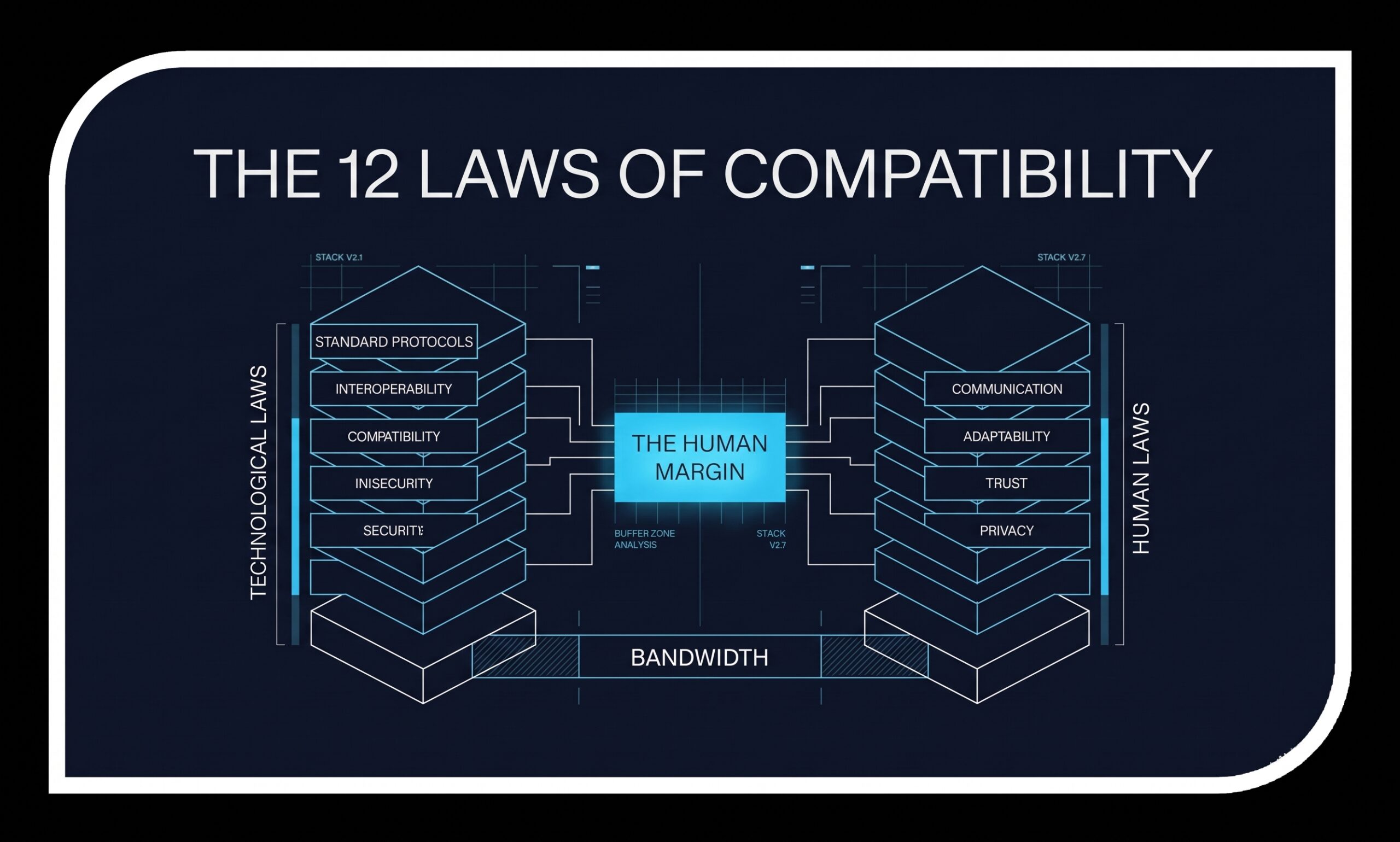
Law 1 — Speed increases throughput: Reducing the time required for an operation makes it possible to execute more within the same timeframe, which increases input density.
Law 2 & 3 — Processing information faster does not mean being able to integrate more simultaneously: Integration depends on the system’s capacity to maintain, link, compare, and organize data. Reducing processing time does not eliminate these constraints.
Law 4 — Information can become a demand: Passive information can actively trigger decision-making, research, or verification processes.
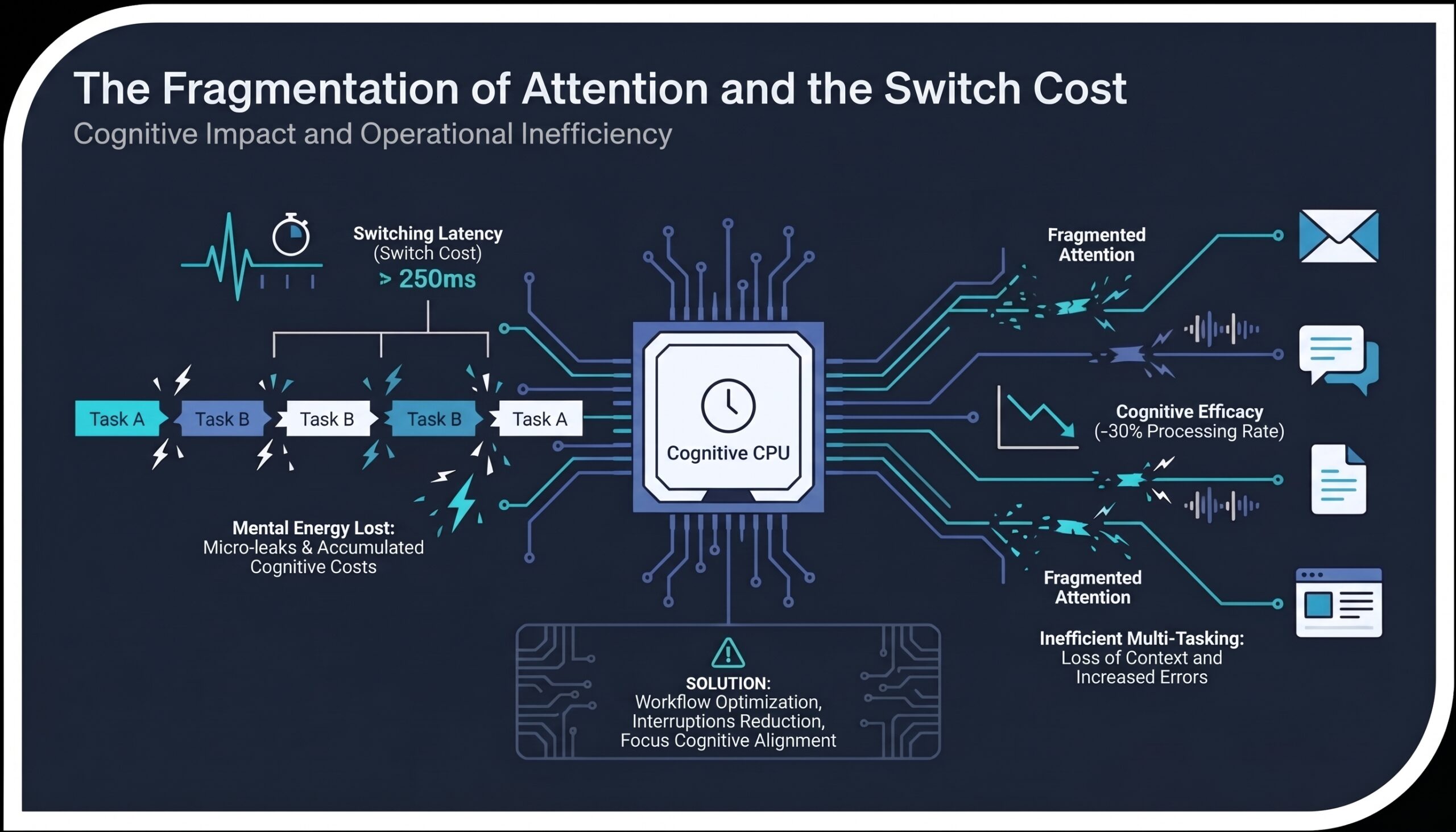
Law 5 — Context switches carry a cost: Shifting from one task to another requires interrupting the first, preserving its state, and rebuilding the context of the second. Fragmentation thus alters processing conditions and consumes resources.
Law 6 — Adaptation reduces certain costs without removing the constraint: Experience enables automation and anticipation, but this merely changes how the system responds to a demand without canceling the initial constraint.
Law 7 — Acquired capacity can become a new baseline: Becoming capable of doing more shifts the expected performance threshold, which in turn generates new demands.
Law 8 — Compensation consumes resources: Mobilizing effort or accelerating to cope with a constraint is not free; compensation itself requires energy.
Law 9 — Available capacity depends on current allocation: The actual capacity of the system depends on active processes (ongoing tasks, trade-offs) at the precise moment a demand arises, rather than on a theoretical capacity.
Law 10 — Margin is residual capacity: This is the operational reserve remaining available to absorb unexpected events without destabilizing the system.
Law 11 — Low margin turns variations into constraints: When the margin is low, any new request forces compensation, a drop in quality, or postponement.
Law 12 — Compatibility depends on the relationship between demand, capacity, and margin: Adequacy is not absolute; it depends on the residual margin retained after responding to environmental demands.
The Asymmetry of Scarcity and Saturation
« Your attention is a narrow channel governed by inviolable physical limits. »
Our biological ecosystem (Hardware) stabilized over the course of evolution within an environment defined by stimulus scarcity and intermittent physical threats. In this legacy configuration, the Kernel (biological core) prioritized allocating minimal energy to detect local variations and rapidly stabilize the organism.
The contemporary digital world imposes an unprecedented scale shift: a continuous bombardment of decontextualized, persistent, and unprioritized data. The nervous system possesses no biological update to cope with this saturation. When the environment saturates your processing capacity, the brain does not « glitch » out of weakness or lack of willpower: it rigorously applies automated compression and simplification processes to protect its integrity.
Understanding this physical asymmetry is the first step toward stopping the fight against your own machine.
The Asymmetry of Scarcity and Saturation
« Your attention is a narrow channel governed by inviolable physical limits. »
Our biological ecosystem (Hardware) stabilized over the course of evolution within an environment defined by stimulus scarcity and intermittent physical threats. In this legacy configuration, the Kernel (biological core) prioritized allocating minimal energy to detect local variations and rapidly stabilize the organism.
The contemporary digital world imposes an unprecedented scale shift: a continuous bombardment of decontextualized, persistent, and unprioritized data. The nervous system possesses no biological update to cope with this saturation. When the environment saturates your processing capacity, the brain does not « glitch » out of weakness or lack of willpower: it rigorously applies automated compression and simplification processes to protect its integrity.
Understanding this physical asymmetry is the first step toward stopping the fight against your own machine.
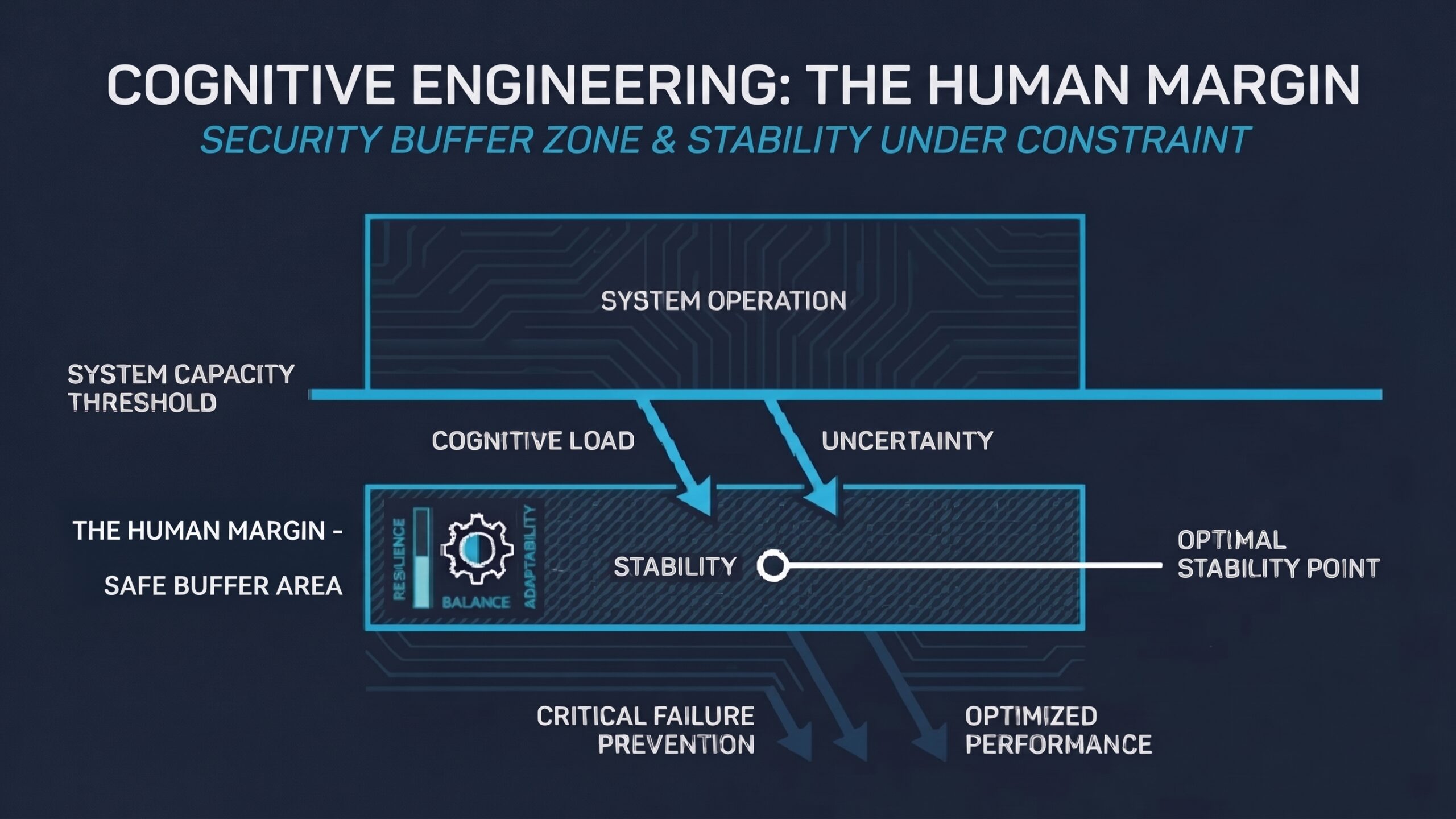
« Margin is not empty space or wasted time. It is the reserve of power that keeps the system stable. »
In traditional performance or efficiency models, unused capacity is perceived as a loss. In Human OS engineering, Margin is instead the most precious safety parameter. It corresponds to the residual attention and energy capacity available after executing your routine background tasks.
A system without margin is a fragile system. Faced with the slightest unexpected environmental disturbance (a conflict, a delay, an emergency), it lacks the tolerance space to cushion the shock. It is then forced into emergency compensation mode: relying on stimulants, perfectionist hyper-control, or seeking escapist dopamine. These temporary strategies create the illusion that « everything is working, » but they ultimately wear down the Hardware and trigger burn-out—the ultimate thermal circuit breaker of safety. Restoring and protecting your background margin is not a luxury; it is the absolute biological condition for navigating the modern jungle with precision and sustainability.