Human Mental Operating System
A Language That Became Universal
When Technology Provides the First Dictionary of the Human Mind
The End of the Cognitive Learning Curve
> « To understand how your mind works, you no longer need to learn a new language. You are already using it every day. »
For decades, accessing an understanding of our own mental mechanisms remained locked behind complex jargon: dense psychological grids, abstract psychoanalytical concepts, or esoteric theories reserved for the initiated. This semantic barrier imposed a heavy entry cost: before even observing oneself, one had to learn a foreign language.
Today, a silent revolution has taken place across the globe. From the 14-year-old teenager to the 84-year-old senior, humanity now shares a common reference framework shaped by the daily use of smartphones, tablets, and computers. Clicking an icon, receiving a notification, running low on battery, or waiting for an update have become universal reflexes that require no analytical effort.
Mental Mechanical Engineering (BRAIN OS) uses this global semantic framework as a reassuring technological mirror. By superimposing the functioning of your brain onto that of the device sitting in your pocket, the BRAIN OS model instantly dissolves complexity. Understanding your mind becomes as straightforward as managing your phone.

The Operating System (OS)
The Invisible Structure That Manages the Machine
> « You do not argue with Windows or Android. You work within their constraints. »
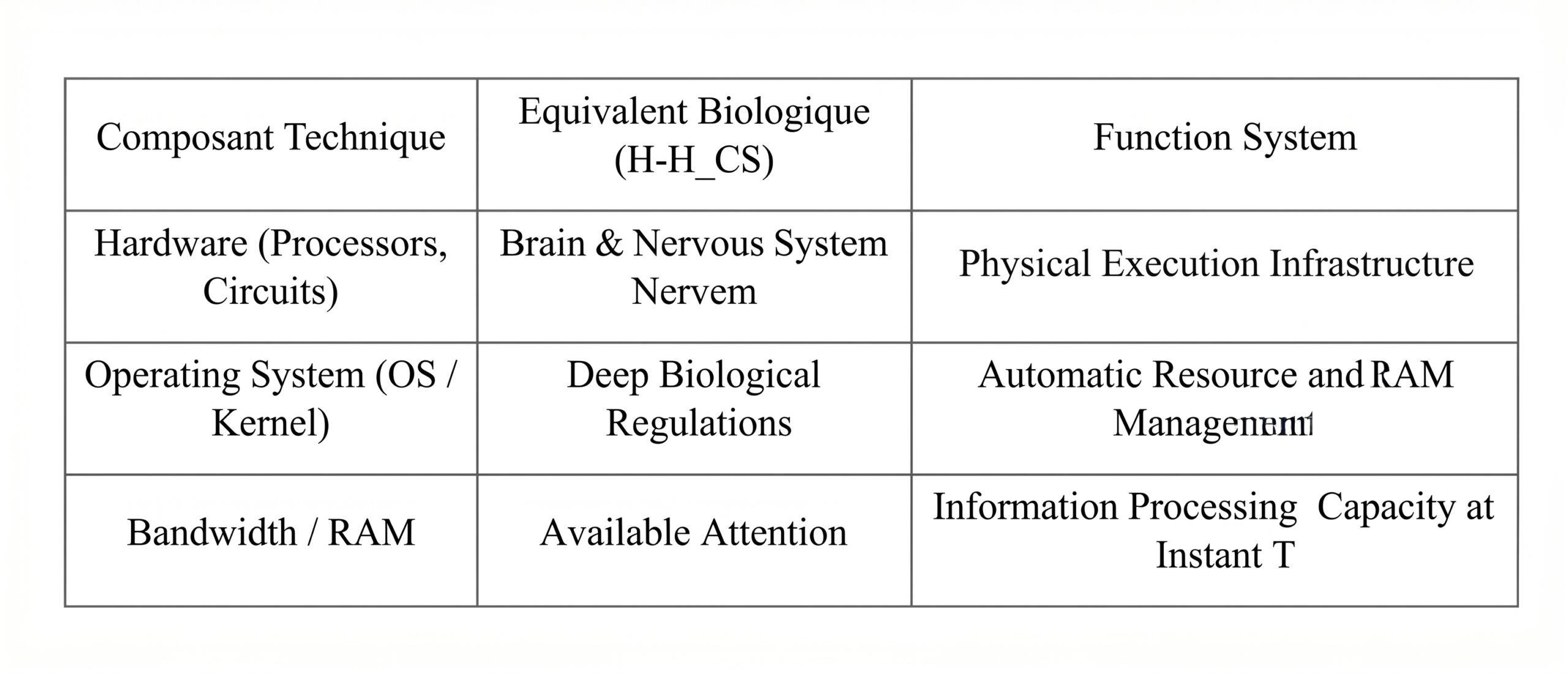
Whether your computer runs Windows, your tablet is equipped with macOS, or your smartphone runs Android, you are thoroughly familiar with the principle of an operating system. It is the completely invisible and silent background environment that manages random-access memory (RAM), distributes power to various components, and allows programs to run in harmony. You do not need to see lines of code to know that if the OS is overloaded, the machine slows down.
Your brain operates in the exact same way. It is equipped with a biological operating system (the Kernel) whose primary mission is to maintain your body’s physical equilibrium and filter stimuli. This operating system has no moods, no morals, and no intentions: it rigorously applies consistent operational rules. Reacting to an alert, sorting information, or shutting down certain analytical functions when energy drops are not character flaws, but routine maintenance operations of your mental OS.
The Application (App)
Ready-to-Run Behavioral Scenarios
> « We click the icon, the application opens. Our mind does the exact same thing. »
To check the weather, verify your bank account balance, or scroll through photos on your social media, the gesture is identical: you tap an icon and the software launches instantly. The application knows its role, displays its interface, and runs in the background without requiring you to rebuild its code every time you open it.
Our minds also harbor a multitude of mental applications accumulated and installed over the course of our lives. Faced with everyday friction (a comment, an uncertainty, a silence), the system does not think from scratch: it clicks the icon of a pre-stored program. Automations such as « Justify yourself, » « Flee conflict, » « Compare yourself to evaluate your status, » or « Anticipate the worst » are literal software applications.
They run in the background, consume your available attention, and drain your somatic energy battery without your knowledge, until you decide to force-quit them.
Comparative Process Analysis:
* **On your smartphone:** A weather app opens $rightarrow$ It connects to the network $rightarrow$ It displays the visual rendering of rain or shine.
* **In your mental OS:** A signal of disagreement appears $rightarrow$ The « Ego Defense » app activates in the background $rightarrow$ It produces a physical render of a tight throat, muscle tension, and anger.

The Instantaneous Generation of Our Subjective Reality
> « Inject a short instruction into the system, and your body will immediately generate the associated physical render. »
With the advent of artificial intelligence, the use of prompts has become mainstream. You write a simple text instruction into a rendering generator, and the algorithm instantly compiles an image, video, or piece of music matching your request. You do not need to know how to draw; the prompt commands the creation of the output.
Your brain operates like the most powerful generative engine. It does not speak in long, logical phrases or complex philosophical reasoning. Faced with a situation, it sends itself ultra-short internal prompts: « I’m under attack, » « I’m going to look weak, » « I’m in danger. »
As soon as this instruction is injected, the Kernel executes the command and produces its immediate physical and somatic render: accelerated heart rate, cortisol secretion, shoulder contraction. The body does not check whether your story is objectively true or false; it does not judge: it applies the prompt and generates the corresponding emotional state in real time.

The Update
The Natural Evolutionary Cycle of the System
> « An obsolete program is not erased by fighting it. It is deactivated by installing a higher-performing update. »
We all accept as a given that our smartphones and computers receive regular updates. Whether it is fixing a security flaw, clearing a cluttered memory cache, or installing smoother features, updates are an integral part of our devices’ lifespans. If you refuse updates, your applications crash and the device overheats.
Human evolution follows this exact maintenance protocol. In accordance with the law of non-resetting, you cannot erase your past or format your biological hard drive. However, you can perform background updates.
Becoming the Webmaster of your machine means learning to spot obsolete lines of code inherited from childhood, cutting the attentional power supply to energy-draining applications running on an infinite loop, and installing leaner action routines better aligned with factual reality. This is not a matter of magical willpower; it is a mental engineering protocol.